


I’ve been thinking a lot about percentages recently. I’ve had two spine surgeries this year, and all things being equal there was a 5-10% chance something could have gone seriously wrong each time I went under the knife.
That chance was enough that my wife and I had serious discussions about the future and our plans in our household. 10% doesn’t seem like a lot, but events with a 10% chance of happening happen all the time.
For example, if you flip a coin three times, all-heads or all-tails occurs 12.5% of the time - just above 10%.
If you meet someone from the United States, all things being equal, there’s roughly a 10% chance they’re from California. If you meet someone from North Carolina, there’s roughly a 10% chance they’re from Mecklenburg County.
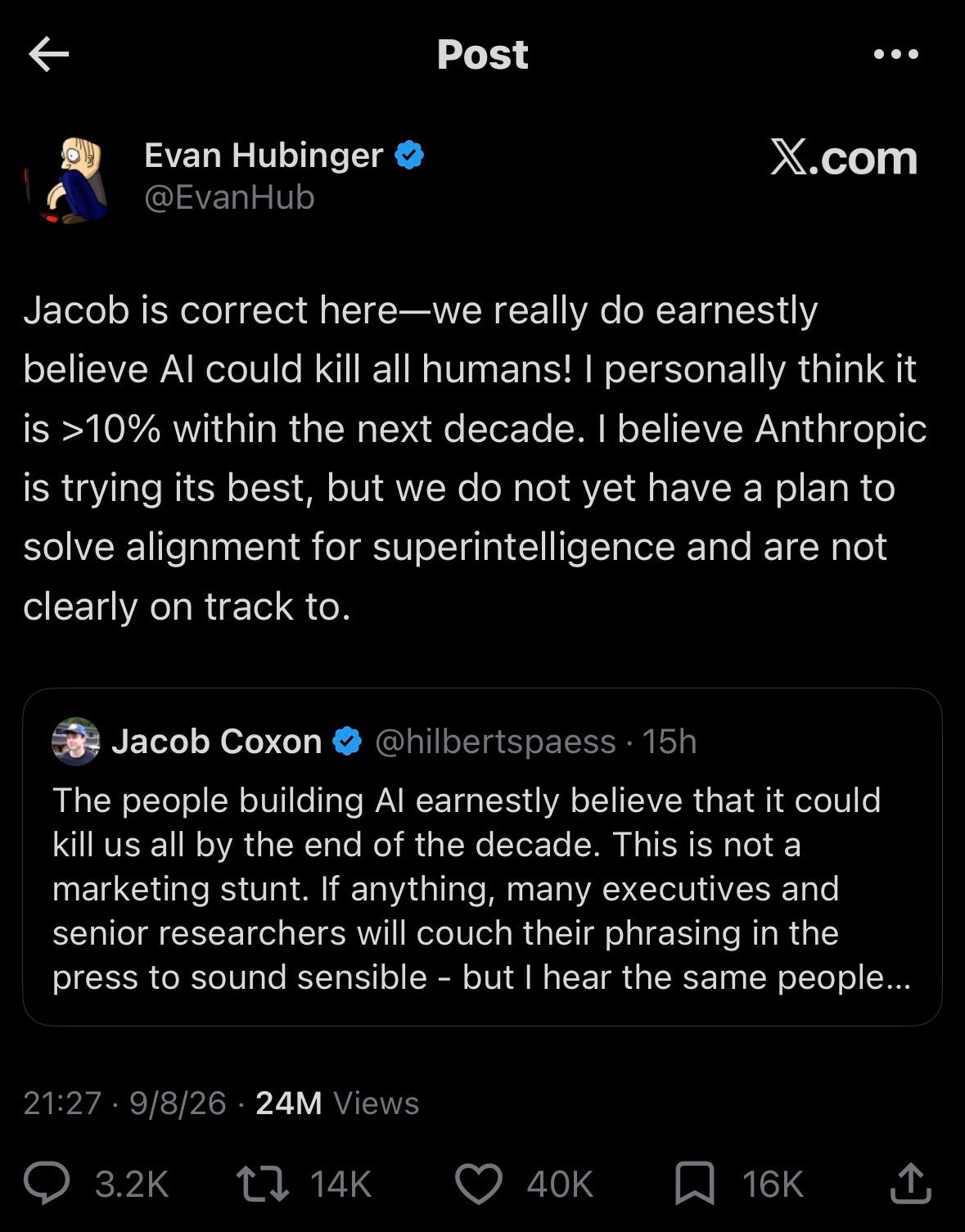
So imagine my surprise yesterday evening when I read a tweet from Evan Hubinger, the alignment science lead at Anthropic AI (aka Claude). Hubinger, ostensibly an expert on artificial intelligence, shared on his personal Twitter account that he thinks there’s a greater than 10% chance that “AI could kill all humans.”
Hubinger later clarified his statement, saying that, “I think the risk from present models is low. What I am worried about is superintelligence arising from recursive self-improvement, as we have said is happening faster than we thought.”
For the uninitiated, “alignment science” is the study and practice of making artificial intelligence do what it’s supposed to do. I’m simplifying here, but if the AI behaves according to human ethics it’s aligned; if it starts hacking systems without permission to complete tasks, it’s misaligned.
So when a person in charge of alignment at one of the biggest AI companies says there’s a 10% or greater chance AI could end the human race as we know it, it’s probably worth paying attention.
The good news is that current AI systems are LLMs or “Large Language Models,” and Hubinger is more specifically talking about AGI or artificial general intelligence systems killing all humans.
The bad news is that when he says we haven’t “solved alignment for superintelligence,” what he’s saying is we can’t make the next generation of AI behave, and we’re way behind where we should be in solving that problem.
Y’all Weekly is an arts and culture rag, so while we could talk about how we’ve seen this film before — the Terminator did say he would be back! — it’s also worth looking at why this existential threat isn’t taking up 10% or greater of our social, political, and cultural bandwidth.
On the social and political side, the opposition to AI — or at the bare minimum, critical evaluation of the industry — isn’t aimed at existential threats (which are hard to envision), but instead is taking the form of opposition to data centers: something tangible that people can see. Data centers are a coup for NIMBYs and other folks who like to protest at city hall because it seems like nobody wants them, and they fit neatly into existing discussions about resource management and climate change. That resistance may be an entry point for more existential conversations about AI.
Politically, most federal and state elected officials and candidates are unaware of what any of this means, which means the loudest voices in their heads are AI companies who come armed with lobbyists and campaign contributions, constituent complaints about data centers, and pollsters telling them opposing data centers is a winning issue. Municipal elected officials are in a different situation, where campaign contributions and lobbying aren’t nearly as effective when data center opponents can organize and pack a city council meeting.
There’s also the idea in geopolitical circles that the U.S. and the West need to win the AI race against China, which is not dissimilar to the logic that led to two superpowers stocking up on nuclear weapons in a mutually assured destruction scheme last century. Just as our ICBMs were the “good” missiles, I’m sure our AGI will be the “good” AI.
In terms of culture, Pluribus is one of the more significant works of the post-pandemic era to touch on AI. It starts by turning all humans into a hive mind (like the Borg) but isn’t about killing all humans so much as it is about how widespread adoption of AI deprives us of the very aspects that make us human. It’s a more complex take on the AI-as-villain concept than HBO’s Westworld or the most recent Mission: Impossible films, and it also makes you wonder why prestige shows about AI are so few and far between:
Pluribus is the first story to properly recognize that there is no going back. AI is here, and we’re already seeing humanity’s bizarre acceptance of it. How it aims to please users and keep them engaged, even if it’s encouraging people to explore dangerous conspiracies. How if you filled a room with ten people, there’s a good chance that you might be the only one who has yet to adopt the technology into your life. And if you screamed that using it would take away our humanity, they might not understand how their new dinner recipe generator is taking away from someone else’s livelihood, sapping the planet of resources at an alarming level, and further isolating us from other free-thinking humans.
If there’s a one-in-ten chance our AI robot overlords are going to be the death of us — or even if there’s just a chance that it’s a 10% chance — we should be having more serious discussions about AI.
It should be the subject of dramas and comedies. Our elected officials should be able to give more intelligent answers than “data centers are bad.” Parents should be able to understand the risks, both existential and personal, to their children.
AI and LLMs are already here and they’re smoothing cerebral cortices across the planet. We should take a critical approach to AI while we still can.