


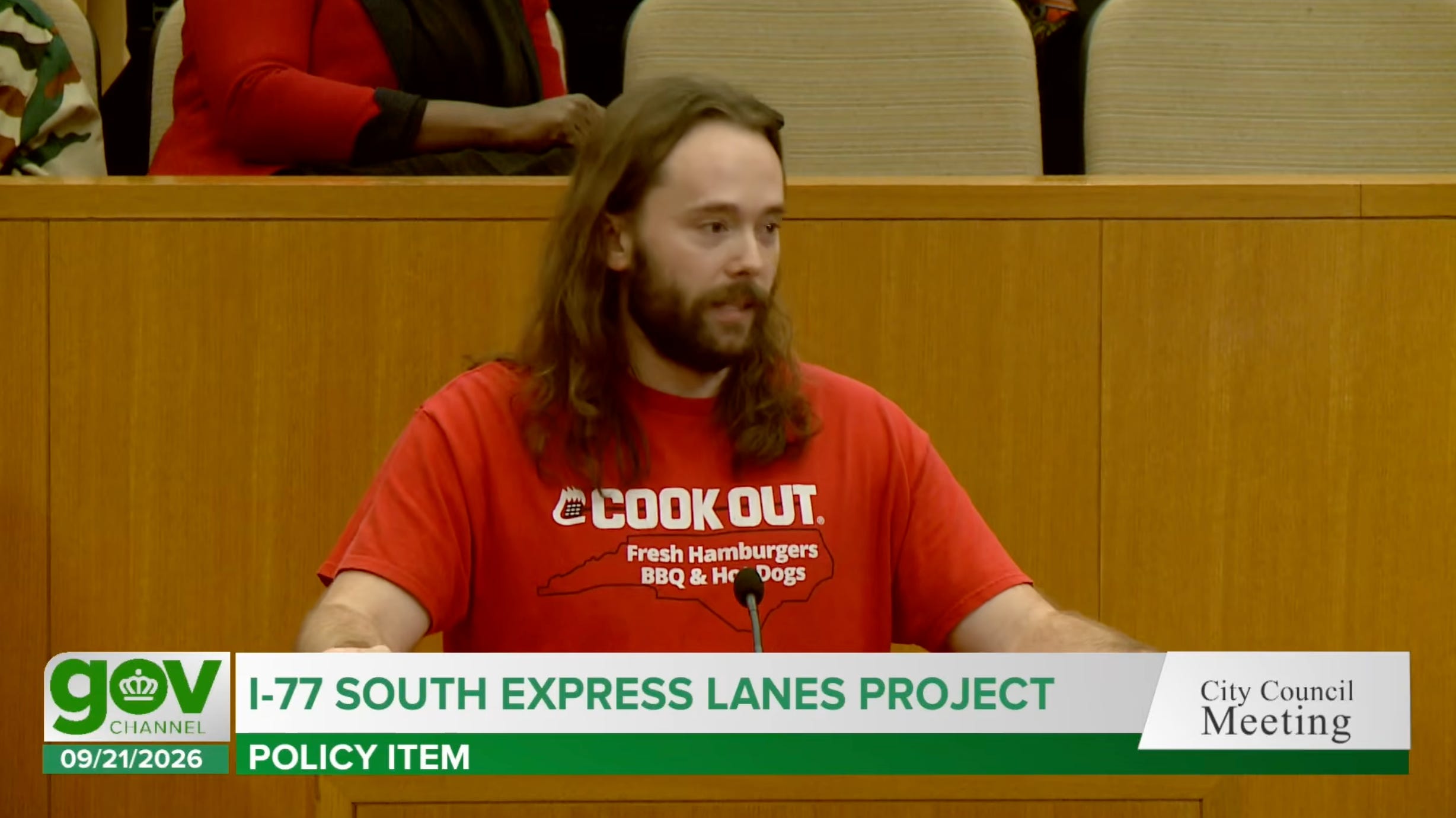
Charlotte City Council Votes 7-4 in Favor of Toll Lane Project
It was a long and winding road to get to a vote, but for now, the Charlotte City Council has made up its mind: the council voted to rescind its previous opposition of the I-77 South Express Lanes project.
Councilmembers Malcolm Graham and Joi Mayo changed their votes from the council’s May meeting, turning a previous 6-5 vote against the project into a 7-4 vote in favor.
Councilmembers LaWana Mayfield, Renee Perkins Johnson, J.D. Mazuera Arias, and Victoria Watlington remained opposed to the project, while councilmembers Dimple Ajmera, Ed Driggs, Kimberly Owens, Dante Anderson, and Mayor Pro Tem James “Smuggie” Mitchell joined Graham and Mayo in voting in favor.
Significant changes were made to the project since that original vote, including a new Memorandum of Agreement (MOA) with the North Carolina Department of Transportation (NCDOT). That agreement “establish[s] each party’s role and responsibilities in Project design, delivery, community engagement, and the development of a binding Community Benefits Plan,” and includes an NCDOT community benefit agreement to “commit a minimum of three hundred million dollars ($300,000,000) generated through the P3 procurement process to delivery of community benefits.”
Despite the change of tune on council, over 50 members of the public spoke at the public hearing before the vote, with over 30 of those speakers against the toll lanes project.
"Traffic is an inconvenience, community harm is permanent,” said District 2 resident Maria Sophia, echoing concerns from many of the speakers.
The Charlotte Regional Transportation Planning Organization (CRTPO) is scheduled to vote on Wednesday on whether to reinstate its support for the NCDOT’s Public-Private Partnership (P3) funding model for the project. With Charlotte now in support of the project, a vote to reinstate the project will pass.
Additionally, with the motion passed tonight, the City of Charlotte and NCDOT are expected to enter into the MOA tomorrow.
This is a developing story. We ask for grace with small typos and mistakes; email sam@yallweekly.com if something catches your eye.
Document: Read the Motion that Passed
Specifically, the motion passed Monday night instructs councilman Ed Driggs, Charlotte’s representative on the CRTPO planning organization, to support the tolls project. Additionally, it authorizes city manager Marcus Jones to inter into the MOA with NCDOT described above.
That motion, in full, is below:
I-77 South Express Lanes Project Action:
A. Conduct a vote on whether to reinstate support for the North Carolian Department of Transportation’s Public-Private Partnership (P3) funding model for the I-77 South Express Lanes Project as required by Session Law 2026-41,
B. Authorize City Council’s Charlotte Regional Transportation Planning Organization (CRPTO) representative to cast a vote on behalf of the City of Charlotte on whether to reinstate support of the P3 at the next CRTPO meeting, and
C. Authorize the City Manager to execute a memorandum of agreement with the North Carolina Department of Transportation establishing a binding framework for community engagement and advancing established local priorities.
Vote to Oppose Tolls Fails
The vote came after a civil public hearing that devolved into protests as it became clear that seven council members, a veto-proof majority, would support the toll project.
After the public hearing, Mayfield made a substitute motion to preserve the status quo. Councilmembers Mayfield, Johnson, Mazuera Arias, and Watlington spoke against the I-77 tolls project, with Mazuera Arias arguing that the legislation passed by the North Carolina General Assembly that proposed up to an $80 million fine for Charlotte was unconstitutional.
That motion failed 4-7, with only Mayfield, Johnson, Mazuera Arias, and Watlington in support.
Next, the 7 council members supporting the new position spoke, starting with Owens, who represents District 6 (south Charlotte).
“My vote is a step to rectify decades-old wrongs in [West Charlotte],” said Owens as she told attendees she would vote in favor of the motion to “go back to the table.”
Councilmembers in favor of the I-77 tolls project, as well as supporters during the public hearing, frequently cited that money that would be used to “reconnect” neighborhoods, reversing years of structural racism in transportation planning that segregated and divided neighborhoods.
“My vote isn’t an endorsement, it is an indictment,” said Owens, explaining her opposition to the entire process as well as the multi-million dollar threat from Raleigh. Owens and others on council made it clear that the state legislature put them in a position they’d rather not be in, stuck with a project that they know will harm the community.
Protesters Removed from Council Chamber
Many speakers and audience members personally called out councilmembers Graham of District 2 and Mayo of District 3, who not only changed their votes, but represent many of the neighborhoods that will be most affected by the project.
“I try to be truthful, I try to be honest, and I try to lean into years of experience representing this community,” said Graham. “And that’s what I’m doing here tonight: representing the community.”
“It doesn’t sound like it!” replied a member of the audience.
Chants and screams interrupted the council as Graham spoke in favor of the project.
“You are disrupting the meeting, please stop talking,” said Mayor Rob Harrington to chanting protestors, many of whom were chanting, “No More Tolls!” during the meeting.
Harrington told the protestors they could be charged with a misdemeanor, and many protestors were eventually removed.
“I understand the history of West Charlotte. I’m a graduate of Johnson C. Smith [University],” said Graham. “I also get that we have to move forward. All of us. If we start dividing ourselves as a community … then we lose our identity. We have an identity. Let’s fight to keep it.”
“I opposed the P3 when it came before us, because I believed it needed more,” said councilmember Joi Mayo, before explaining many of the benefits that would come to her district, which has the most miles of I-77 that are part of the project.
Emphasis on Silver Linings
Driggs framed the agreement as a new playbook for dealing with NCDOT.
“We need to look at it as a success,” said Driggs. “300 million dollars in cash at closing. There’s no uncertainty about that.”
“I hope that as we move forward, the benefits to West Charlotte will be apparent,” Driggs added.
Another silver lining: both members of council in opposition, and those in favor continuously thanked the City Attorney’s office as well as the many public employees and community members who negotiated with the North Carolina Department of Transportation (NCDOT) to come to progressively better deals, including the MOA.
After every member of council had their say, the 7-4 vote in favor of rejoining the toll project was a fait accompli, with council adjourning shortly after.
Vast Majority of Community Comments Against the Toll Lanes Project
A Y’all Weekly tally counted over 70% of the approximately 50 speakers in attendance opposed the City changing its vote on the I-77 toll roads.
“Everyone knows it's not going to work,” said Corbin Smith, a self-identified Republican, one of many speakers who brought up concepts like induced demand, which says — in civil engineer terms — that if you build it, cars will come, and congestion will eventually remain the same.
Rosemary Lawrence-Young, a McCrorey Heights resident, appealed to those who knew the history of her community and many that had been affected by past transportation decisions.
“I ask you to keep your promise,” she said, referring to the May vote. “We are speaking to you, we are pleading to you, keep your promise.”
Greg Jarrell was pointed with his criticism of the project, and like Lawrence-Young was one of many speakers who believed that history was repeating itself with the I-77 project.
"Urban highway system is our most enduring monument to white supremacy,” said Jarrell.
James Cole invoked history in a different way, comparing the opposition to the I-77 project to local opposition to Charlotte building an airport during the 1930s and 40s.
Rickey Hall, a longtime West Charlotte resident and community activist, was also in the minority speaking in favor of the project.
“[It’s an] opportunity to reconnect neighborhoods,” said Hall. “If we do it right, people can see real and lasting benefits.”
Both Hall and local NAACP president Corine Mack got shoutouts from Mitchell for their support of the project.
You can watch the meeting in its entirety here: