


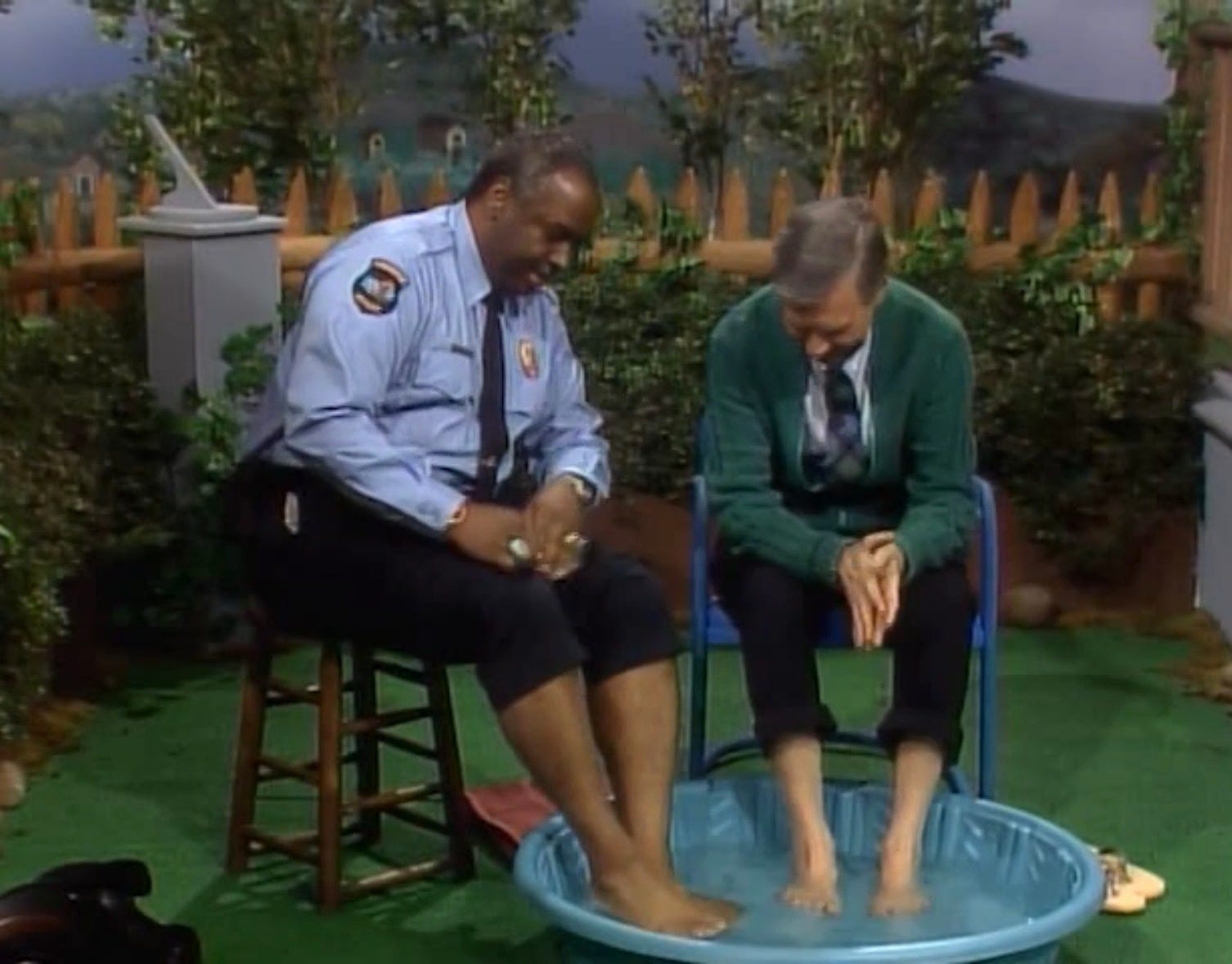
“Often when you think you’re at the end of something, you’re at the beginning of something else.” - Fred Rogers
Today, after six decades, the Corporation for Public Broadcasting officially dissolved.
We’re sharing their official statement, in full, below.
Today, the Corporation for Public Broadcasting formally dissolved as a corporate entity.
For nearly 60 years, CPB stewarded the federal appropriation for public media in ways that enhanced the lives of all Americans, ensuring everyone, regardless of where they live or how much they earn, has access to public media and the essential services it provides, free of charge. As a whole, public media provided such value, at so little cost to the taxpayer, that it received bipartisan support for decades and few thought it would be defunded.
However, throughout 2025, CPB and public media became the target of heightened, relentless partisan attacks with the goal of defunding CPB. Millions of Americans who value their public media station and recognize that public media’s trusted, educational and informational content is vital to our democracy, expressed support for public media and petitioned Congress to preserve federal funding for CPB.
Against the wishes of the majority of Americans, in July 2025, Congress defunded CPB by passing the Rescission Act of 2025 — a maneuver that enabled Congress to “claw back” already appropriated funds by just a single-vote margin.
Since then, CPB has survived mainly on private donations because Congress failed to provide basic closing costs. The CPB team has worked with unwavering professionalism to honor existing commitments and distribute remaining grants to local stations, producers, PBS, and NPR, even when only a handful of us remained. We mark their dedicated service with respect and gratitude.
Some have asked if CPB could survive on private donations alone until a more favorable political climate emerges that would favor restoring funding to CPB. The CPB Board of Directors gave very careful consideration to many options and concluded that dissolution was the only responsible path.
The longer CPB tried to exist without funding, the greater the probability that our remaining funds would never reach the public media system. Moreover, we grew increasingly concerned that funding directed to public media could become subject to new content restrictions, and that compliance would further harm stations and erode the trust we worked decades to build.
These risks were real and dangerous, and we would not allow them to take shape.
We could have survived by complying with demands for political control over news coverage, by rewriting history, by limiting the stories and information shared with the American public, by abandoning diverse talent, or by supporting content that increases divisiveness through disinformation.
But the American people deserve more. So, CPB took its last stand.
We invested in the innovative, sustainable solutions that will empower public media to survive in our absence.
Since October, we have provided over $170 million in funding into organizations, stations, and programs with the power to carry public media forward.
We made strategic investments that preserve public media’s legacy and strengthen its future, safeguarding the American Archive of Public Broadcasting so our shared civic history endures; maintaining national distribution of locally produced programming through American Public Television; supporting trusted, research-backed educational content; commemorating the nation’s 250th anniversary through StoryCorps; and advancing rigorous research that documents public media’s impact and role in supporting our democracy.
All of these measures reflect CPB’s enduring purpose: to strengthen education, preserve democratic memory, amplify local voices, and ensure that public media remains valuable to the public it serves.
The Board took the heart-wrenching but necessary step to dissolve this venerable institution not only for financial reasons but to protect CPB from continued attacks or other interventions that would diminish the institution, as has occurred at other federally funded agencies.
We are grateful for the public’s decades of support for our mission and work, and thankful for your continued support to local stations struggling in the wake of the rescission.
The Public Broadcasting Act, which envisioned a public media system that put the public interest above profit, still exists. Let us look to a future when public media funding is restored in ways that honor that mission.
Thank you.
Often when you think you’re at the end of something, you’re at the beginning of something else. - Mister Rogers
Over the past year many of the important pieces of the cultural fabric in America have been torn and frayed, but not destroyed. It’s a challenging time for public news and local information sources, and often, they’re fighting an asymmetric battle against national narratives delivered by corporate media.
Artists and cultural institutions are not only up against addictive, dopamine-producing content from reels and streaming services, they’re battling against the loneliness epidemic and the decline of civic society and social capital. Ask any party or event planner how hard their job has become when the idea of the couch gets increasingly comfortable with each passing year. Community theatre producers and museum directors would probably agree.
The foundations of civic society — the arts, independent movie theaters, museums, and local information sources — are asking folks to step out of their comfort zone, and en masse, folks are replying, “No.”
Or maybe just, “Huh?”
The old reporter adage - attributed to Finley Peter Dunne - that the job of journalism is to "Comfort the afflicted and afflict the comfortable" has taken on new meaning as people are steered towards reporting and opinion pieces that reenforce the barriers of their bubble.
To stay true to purpose, art, culture, and journalism not only have to challenge people in power, they have to challenge their audience without losing ears, eyeballs, and fingers to apathy.
Many of the organizations and institutions that are closing their doors weren’t prepared to take on civic entropy, loneliness, and the chaotic disinformation machines of the Internet Age. However, there is hope. As Fred said, “Often when you think you’re at the end of something, you’re at the beginning of something else.”
One of our goals at Y’all Weekly is to be a part of the “something else.” We got started in 2022 with a manifesto of sorts from our co-founder, Jesse Kimmel: our community is full of amazing writing, art, and culture, but too often, “Y’all didn’t know about it.”
Recently, Jesse has joined our local NPR affiliate WFAE for “First Friday Arts” segments to get the word out, but there’s a lot more we can do as well.

Part of that is supporting the other folks who are part of the “something else.” If you live in Charlotte or the Carolinas, and haven’t subscribed to some of the below publications that are doing things differently and adapting to the moment, you’re doing yourself a disservice:
That’s just a short list that doesn’t even include any of the great Carolina publications that publish in languages other than English - we hope you’ll seek those out too.
At the end of the day everything we do is about community, and even without the Corporation for Public Broadcasting, we hope to be a part of a strong, locally-focused, independent, and collaborative future for journalism and the arts.
Thanks for being a Y’all Weekly subscriber.